Loons in November

I have already outed myself as a casual birder and one bird that is easy for an amateur like me to identify is the common loon. It is one of the few birds that I can quickly identify from its call. That shrill, eerie shriek from across a lake or pond has always been a welcome ambient noise while enjoying summer in Maine.
I thought I knew a lot about loons. They have a distinct black and white plumage, they live in fresh water, they can’t walk on land, and they have ruby red eyes. For me, that was quite a lot to know about one type of bird. Except that all of my ‘knowledge’ is only partially correct. Do you know what Maine loons are doing right now in November? They are moving to the ocean and changing the color of not only their feathers but also their eyes.
This was huge news to me. I started asking family and friends where loons go in the winter as an unofficial poll. One friend knew exactly where they went and that they changed so much of their appearance but most guessed that loons flew south for the winter and were surprised when I spilled my newly acquired knowledge about loons.
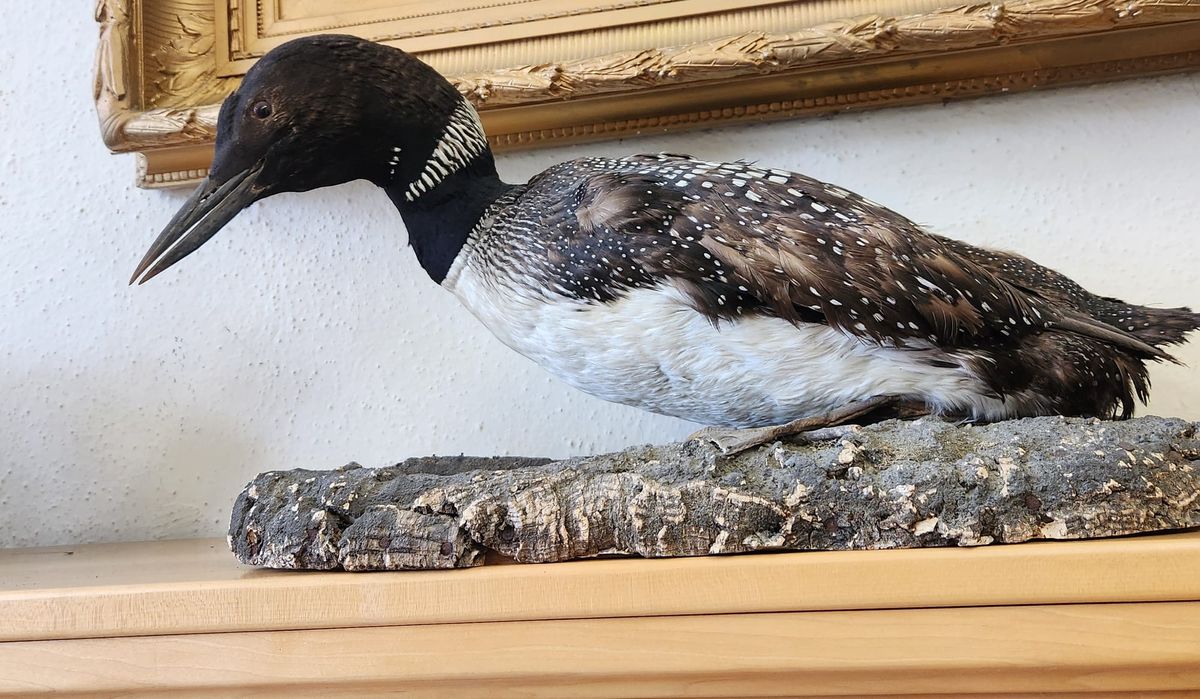
If you are wondering how I got to this level of curious loon lady, it all started at the library. In my travels I have seen four loon mounts located at public libraries in Maine. I was delighted for the opportunity to see these fascinating birds up close, to study their details, and appreciate their size. I have seen many loons in Maine’s fresh waters, but I have never gotten this close to a loon where I was able to gauge their actual size and features.
Each time I came across a loon mount I felt those little bubbles of excitement. Most were displayed behind glass or above reach to protect them from curious hands. I would get as close as I could to the bird taking in its detail and beauty. At each display, I used my phone to take a photo wanting to document what I had seen, plus I could zoom in and see more details on the mounts that were out of reach. I felt confident that I knew, as mentioned above, quite a bit about loons. I didn’t question what I was looking at, this was a loon, I knew their colors, their calls, and where they lived.
Then while my eyes were gazing at the loons' decorative black and white pattern a question popped into my brain, where does the loon live when the lake freezes in the winter? Maybe they fly south, I thought in a dismissive tone, but I wasn’t quite satisfied with that answer. I made a mental note to look that up later. Curiosity had invaded my thoughts and I just had to know.
I was not prepared for what I was about to learn about loons. While some do in fact fly south to places such as Maryland or New Jersey, most Maine loons fly to coastal Maine and reside in the ocean. That’s right, loons migrate when the lakes and ponds in Maine start to freeze, and trade in their freshwater habitat for the salty ocean environment. I thought there must be a word for birds who are both freshwater and saltwater dwellers, but I have yet to find a word that describes this occurrence.
More facts about loons that I was not prepared to learn is that much like us Mainers, the loon packs up its summer attire and pulls out the winter wear for the cold season. I would likely not be able to easily identify a loon in the winter as it wouldn’t have its black and white pattern to aid my identification. The loon’s winter wear is a dull grey and brown coat of feathers, with a white neck and belly. If you think their ruby eyes would at least help with reference, nope, that also changes in the winter. Their eye color turns just as their feathers to a brown or grey shade.
All of the loon mounts that I saw were represented in their summer wears of black and white plumage. I got so much enjoyment from seeing these loons up close and in detail. I am inspired to spend some time on the Maine coast in the winter and spot a loon in its winter coat. I may be slowly transitioning from a birder who views birds from locations that I happen to be into someone who seeks out seeing certain birds.