Surprising Art
"I was initially put off about the thought of art made out of literal human hair..." A library visit turns into an unexpected journey into a 19th-century art form. Read how a unique discovery in Corinna, Maine, highlights the incredible history displayed on our local library walls.

In the spirit of October being spooky season that can lead us into thinking about oddities and curiosities, I want to share an art form that I learned about during my library adventures which I had never encountered before.
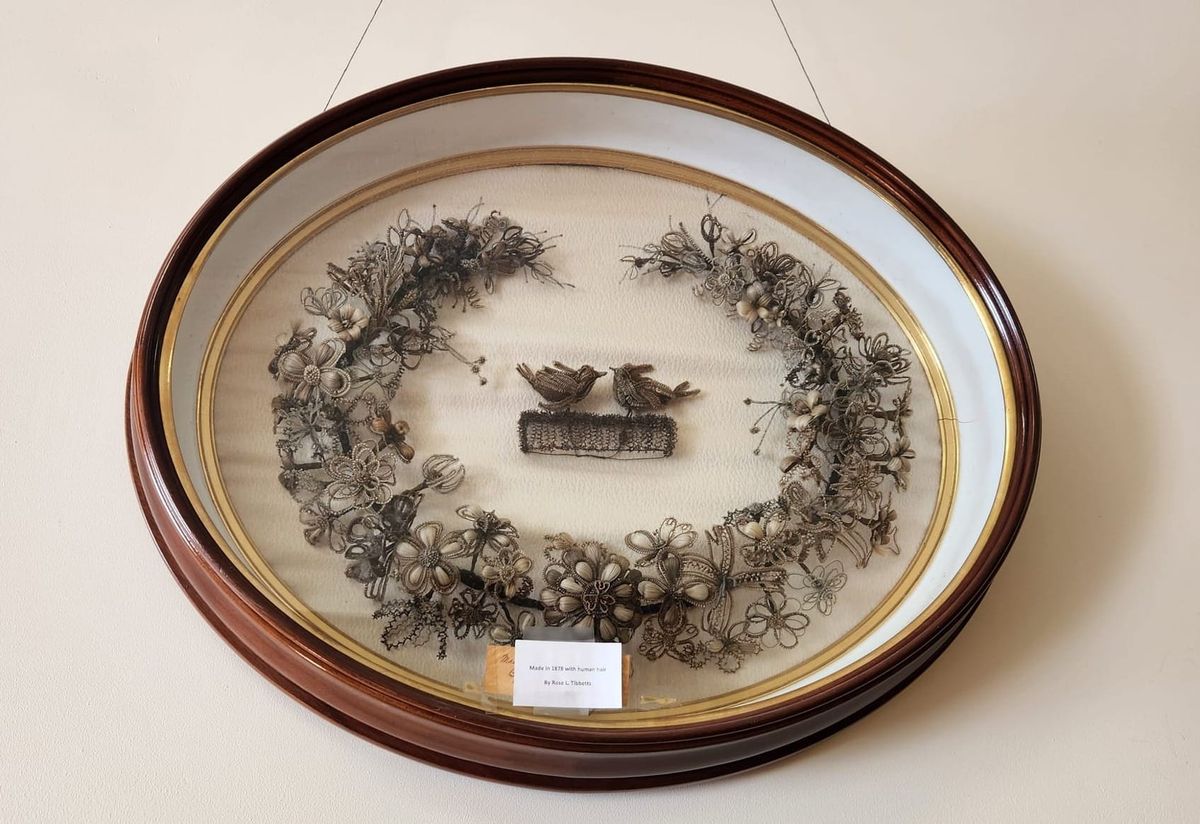
Art materials can be a variety of things, but discovering human hair as a medium took me completely by surprise. I felt a bit shocked and uneasy at first looking at this art piece seen in the cover photo. This was made out of real human hair. I was looking at real human hair. Why did this give me an uneasy feeling? Probably because it was a foreign concept to me and I was unfamiliar with the history and meaning behind it. Once I started researching and learning my feelings of unease turned into appreciation and intrigue.
When visiting the Stewart Free Library in Corinna, Maine, I saw my first piece of hairwork. I stood below the piece mounted above a fireplace in awe and unease. I knew I wanted a closer look but because I am not very tall, I used my handy trick of taking a photo with my phone and zooming in for a more detailed look.
There was little information associated with the piece, just a small inscription that said: Made in 1878 by Rose L. Tibbetts. This is where my brain sparked into question mode. Whose hair am I looking at? Why was this made? Why is this at the library? Who is Rose Tibbetts? I asked the librarian about the piece but her only information on the piece was the inscription. I was itching to learn more.
I made a running list of research questions inside my head for later, starting with the basics, what is hair art? Would I be able to find a video showing me the process of how it is made? That night, my face aglow by my laptop screen, I found myself in a deep dive into hairwork and, as I learned about the traditions and purpose behind the art, I noticed my feelings shift from unease and aversion to respect for the artform and delight in having seen such a unique piece of art. I got to view a 148 year old work of art that someone made with purpose and precision, how cool is that? It felt like an honor to have seen this piece in person.
Art made from human hair is called hairwork. This type of artform was popular in the 1800s, which gave me a little context into the piece at the library which is dated 1878. To create hairwork, human hair is used to create embroidery style pieces of art. This art form is very delicate and requires a precise hand. Hair is weaved with knots and twists often to make dainty floral designs. Popular displays of hairwork are framed in shadow boxes or made into wearable jewelry.
The more I read about hairwork and compared my research to the piece at the library, which was framed in a shadow box, I understood how traditional this piece is. The drive behind creating this type of art was mostly to create a memento of a loved one who has passed. It was part of a family's mourning process. This art form was also used to create tangible family trees with hair from each family member creating the leaves on a tree in a generational order. Another purpose for hairwork was to create a piece to give to a close friend or romantic partner symbolizing giving a piece of oneself to another.
The hairwork art at the library is like a pop culture item of the 1800s. This specific piece is floral with two birds facing each other in the center. Looking at the cover photo, if you didn’t know this was human hair, what would you think the art material was? I thought it was thread or embroidery floss initially.
After researching Hairwork and then viewing this piece with a more critical, albeit very amateur eye, I would guess this is a family piece because of the variety in hair used. Could the two birds represent two parents with the wreath consisting of their children’s hair? The more I look at the piece the more details and intricate designs I notice. The flowers have many layers. The hair is so smooth, not a strand appearing out of place. The larger flowers remind me of a brooch. Since learning that hairwork was often fashioned into jewelry I could imagine how a singular flower from this piece could have been fashioned into a wearable broach. The piece is stunning, beautiful, historic, and meaningful.
An unexpected outcome to visiting so many public libraries in Maine has been an education and awareness of art. Many libraries have art galleries, and I can say that seeing these art galleries (for free!) has enriched my life. Another lesson that was clear to me with this specific art piece is that when faced with feelings of unease or aversion oftentimes learning more can shift those feelings. I will admit I was initially put off about the thought of art made out of literal human hair and now I am in deep appreciation. I hope to share more information about art and things I have learned and seen along the way while I visit public libraries in our home state.